Picture Perfect
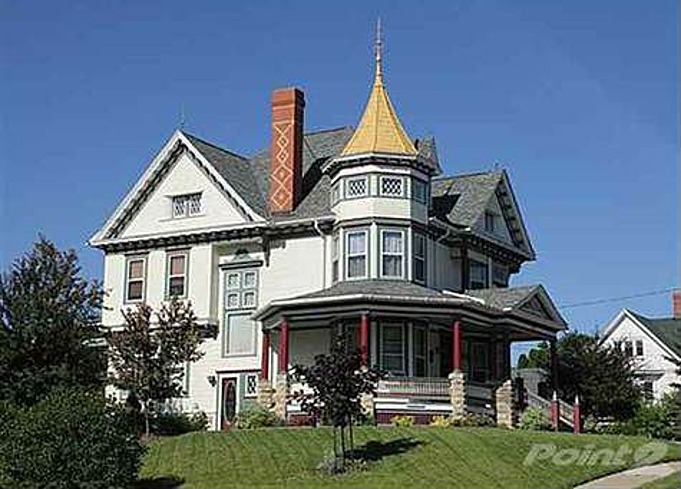
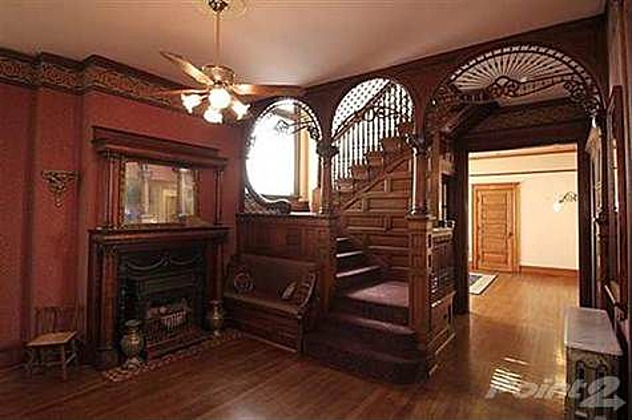
Picture this: A grand Queen Anne-style house, big but not too big, just off the square in a small midwestern town. Like a Gibson girl, the house burst out all over, a bay window here, a strand of fancy carving there. Summer nights on the fat wraparound porch we watched wedding parties gather outside St. Mary’s across the street. Strangers–guests at the wedding, perhaps–stood on the sidewalk and pointed up at our attic’s diamond windows. We talked to them sometimes, answered their questions. “That room there, that’s the one I’d want,” they always said. And though it felt unseemly, I’d explain that those windows sat at knee height in an unheated, unfinished attic. They were, like so much about that picture-perfect house, just for show. “I’ve never seen anything like this!” those same strangers exclaimed minutes later if we invited them inside, which we sometimes did. They gasped at the delicately carved staircase, the leaded glass cupboards in the entry and dining room, the filigreed wooden sunburst above the pocket doors between the parlor and entry. “Oh,” they gushed. “You are so lucky. It’s a dream house.” At first, a year or two after we moved in, I happily agreed. Then I started pausing. “Yes, I suppose,” I’d say. “A lot of work, though, always something to do.” And then, still later, “It’s just a house, after all, just another old house.”
Right about then–maybe the first or second time I found myself saying that–we stopped talking to the people. I’d pull back a lace curtain sometimes and watch them across the street, staring up, pointing at the carved wreath above the picture window or the patterned brick chimney, snapping photos from the walk. “Let them nurse their fantasies from the curb,” I’d mutter, vowing not to spoil the picture. But I’ll say it now: life in a dream house, a castle, is not all it’s cracked up to be. Castles have moats, barriers you feel, but can’t see right away.
Pictures caught all the place’s glory–the wraparound porch, copper-topped turret, the wreaths and swags, bays and bows–in flat, matte or glossy 4x6 rectangles. But film never captured (snd strangers never spied) the phantoms who haunted that dream house; the scowling women at the post office, the creakingly empty chairs around the dining room table each Saturday night, the silent chorus serenading us with our own out-of-placeness, each time we arrived home.
You can fall in love with a picture, but you cannot live in its silent, empty world. Most people already know these things instinctively, and hold their house dreams in check. I had to learn the hard way.
This is where the story gets complicated. Squinting into the past, it isn’t clear exactly what went wrong, why we felt hemmed in by our house, isolated from our neighbors, like misfits who’d never be welcome at the firefighter’s fishfry or the homecoming parade. If you’ve read Main Street, you know the story. Small towns don’t change; Sinclair Lewis nailed them in 1920. People who don’t fit on Main Street are chewed down to size. One of the worst things you can be in such a place is a newcomer who is irrepressibly full of ideas. My version of the story had this twist: The very worst thing you can be in such a place is a newcomer, full of ideas, who is also houseproud.
Clearly, it was impossible from the start. What–my friends ask me now–was I thinking? How did I imagine I could live in a tiny nowhere place? What made me think people in a tiny nowhere place could live with me? How could anyone expect a house, even a dream house, to provide a dream life transcending its tiny spot on the map?
Was it an illusion, were we taken in by the house’s beauty? Was it the way the place seemed to float there atop its gently sloping lot, set apart from common neighbors–turret facing off against the steeple across the street? Though plopped squarely in that very straightlaced little town, the house felt out of time, set apart. Whether, in the end, it was set apart too much, or too little, I still can’t say.
Perhaps the problem was lodged in my childhood, as Mom and I moved through a dingy series of apartments–one over a laundry, another above an old-time grocery run by unmarried German sisters, yet another in the bottom half of what had once been a farmstead. With each move, I fixated on other people’s lovely homes. The bluffs of our old Mississippi river town offered a fantasy feast; dark faux-Tudor palaces that fed my inner princess, but also top-heavy Italianates, extravagant Queen Annes, stolid Colonial Revivals.
“I’m going to live in a castle someday,” I told myself, sure that life was as pristine and perfect inside those grand old houses as it appeared from the crumbling sidewalk. Even back then, I must have doubted the connection. Our life never mirrored the ugliness of those apartments. I felt happy and secure sleeping with Mom in a shared bed. And yet I clipped dream rooms from the J.C. Penney’s catalog and paced floorplans in the alley. I knew exactly what my imaginary room looked like in each fantasy house, the white canopy twin bed topped by a pink chenille poodle coverlet. Lying in bed in our front room above Schneider’s grocery, I watched dancing light from the blinking sign outside and fantasized about what kind of swingset I’d get if we ever lived in a house with a yard.
So perhaps my dreamy path was predicable. In college and later, as a single reporter, I rented apartments based on charm rather than convenience. Married, I quickly talked my condo-dwelling husband into a quirky little cottage long on character but short on space. With two babies in 18 months, we set out hunting for new, roomier quarters. That’s how we stumbled onto the dream house. Timeworn but still grand, it was in the town up the highway where Mike commuted to work. The place was a bargain, half what we’d pay for a similar house in our city’s booming market. Even the sagging gingerbread, vine-obscured porch, and peeling paint didn’t deter us. Dream houses take work–we knew that–and money, too. We were ready. It was time to make ourselves at home.
Our few misgivings centered on life in a tiny town. With its 2,500 inhabitants, our new hometown was the size of my urban high school. I had never imagined living in such a small place. Mike grew up on a farm outside a town like this one and considered escape a victory. But we were in love. Our city was just 30 minutes away. Surely, we thought, we’d get used to life on a small scale. Surely the town would be happy to have us. I’m not sure, even now, which assumption was most mistaken.
It’s a “pretty good” town, the kind that moves Garrison Keillor to spin charming stories. Almost everyone is Catholic or Lutheran, with a sprinkling of Methodists and Presbyterians. Spring and fall tractors and combines crisscross the town square moving between farm fields that stretch in all directions. Houses are mostly tidy and smallish, garages enormous and immaculate. Every spring the Farm Bureau sponsors a “Coloring Inside the Lines” contest and most parents, if they pay attention to such things, hope their sons or daughters win. Each December, carols blast the town square from speakers on City Hall, and most everyone approves. To insult anything, people say it’s “different.”
In the eyes of a true outsider–somebody from Minneapolis or Chicago–we probably didn’t look different from our neighbors. We were older, in our early thirties with a toddler and a newborn. Most people our age were already busy organizing the wrestling boosters, chaperoning their teenagers on FFA trips, or collecting door prizes for the after-prom party. As college-educated, middle class people, we were also slightly more prosperous and considerably more bookish than average.
But the big differences–the ones stocking a moat expanding around us even as we blithely unloaded boxes of old Mother Jones magazines and began hanging our collections of vintage hats–were things you couldn’t see in our family portrait. Neither of us hunted, bowled, or played softball, we disdained country music, collectible figurines, and steak houses. Worse yet, we had given away our television and, as non-believers, did not join a local church. There was also the troubling matter of my last name, which is not the same as my husband’s.
When we first moved in, I decided people were shy. That was the only explanation for the unfriendliness, the poker-faced old ladies in the library, or the old fellow who watched me walk by his porch each day without a nod. But the chilly reception was not limited to old people. When I tried to hook up with a local playgroup, the woman I approached about it in the park became suddenly silent and uncomfortable.
“That group, it…it doesn’t really exist anymore,” she said. “Some friends still get together informally. But it isn’t official or anything.” If I wanted to start my own playgroup, she directed me to the community bulletin board. I could make a sign, she said. Thanking her, I walked home and tried not to feel snubbed. Over the next six years we kept bumping heads against an unbudging wall of stand-offishness. I never warmed to the town beyond my front door, nor it to me. I served on boards, volunteered at school, launched a playgroup and a historic preservation society. But nothing brought me an easy niche in that stiff-necked little town. We doggedly invited neighbors and acquaintances to dinner, or along on picnics. That second summer the whole block celebrated Independence Day–complete with red, white, and blue Jello–at a cookout in our backyard. But invitations were almost never returned. When we were invited to anything, it was generally a direct-marketing “party” pitching investment schemes or makeovers or weight-loss products.
Even attempts at good citizenship were rebuffed. I was called “trouble maker” for advocating the simplest things–sidewalk repairs, for example, and library expansion. Turned out I was the town’s only resident who thought it wasn’t perfect. If I didn’t like life there, people said again and again, the road out of town traveled right past my house.
Much as I wanted to blame my fellow townspeople for our isolation, the problem wasn’t entirely one-sided. Finding community proved a lot more complicated than I had imagined. Simply by virtue of moving in, owning a house, investing myself in it, I had assumed I automatically belonged there. But it didn’t work that way. In fact, I found the town and its goings-on completely uninteresting. None of it was for me: not summer softball at West End Pond nor Friday night Ladies League at the Burg Bowl. I didn’t consider pizza ethnic food. I had no interest in scrapbooking or decorative stamping or getting rich shilling Mary Kay. There were Bible study circles aplenty, PEO programs on collectible Barbie Dolls, monthly gatherings of the Happy Homemakers and the Republican Women. But I turned up my nose at all those things, as well as at Tupperware and Longaberger Basket parties, social calendar mainstays. Maybe that’s why we poured ourselves into the house–scraping and painting its elaborately varied siding, reglazing over 40 windows, restoring the porch, refinishing the floors, repairing the walls. At naptime, I climbed a ladder on the porch, baby monitor clipped to my shorts, and scraped the peeling ceiling. Mike took the month of August off and built a three-story scaffolding to paint the highest peaks of the roof. More than simply a residence, the place was our hobby, our obsession, our very identity. “Oh, you live in that house,” new acquaintances would say, nodding knowingly. Our house told them everything.
With every project the house neared perfection. The better it looked, the more lonely and isolated I felt. What good is a beautiful dining room–oak floors polished, ceiling glittering with hand silk-screened gold stars–if no one is coming for dinner? I waited for the fog of our isolation to lift, for something to happen to me driving back into town, coming over the rise from the interstate, past the anemic six houses of a slow-starting subdivision, the Ford dealer, Veterinary Clinic, several body shops, and a fancy new funeral parlor. I kept waiting to feel like I was coming home. A warm rush, maybe, an eager curiosity about the vacant house near Supervalu, or pleasure passing the single, turned-off traffic light. But that never happened. Resignation sat like a stone in my stomach. “Oh yes,” I’d sigh to myself. “Here I am again. Oh well.”
Hard as I tried to feel at home, to change the song in my head (to something by Garth Brooks, perhaps, or Shania Twain) the soundtrack to our life there was always in David Byrne’s spooky, knowing voice. “This is not my beautiful house,” he sang. And I had to ask myself, “Well…, how did I get here?” And where did that highway lead to?
Back before I thought much about it, I would have said community looked something like Hillary Clinton’s village, a place crayoned onto a UNICEF card, where folks band together and many hands make light work. Small town life would be something like a quilting bee or barn raising, I imagined, with fireworks, sack races, and a talent show in the town square. Maybe it’s like that for some people. But you have to earn admission to the festivities. And you have to really want in.
For us, the cost of living in that castle was too steep. We finally moved back to our city. A portrait of the dream house hangs on the wall here, right above the piano, another member of the family, like a flamboyant aunt who takes a great photo. And the little town up the highway? I suspect its happier, too, with us out of the picture, not there find fault, feel snubbed, plot change. Everything is fine there now, I’m sure. Everything is the same as it ever was.